

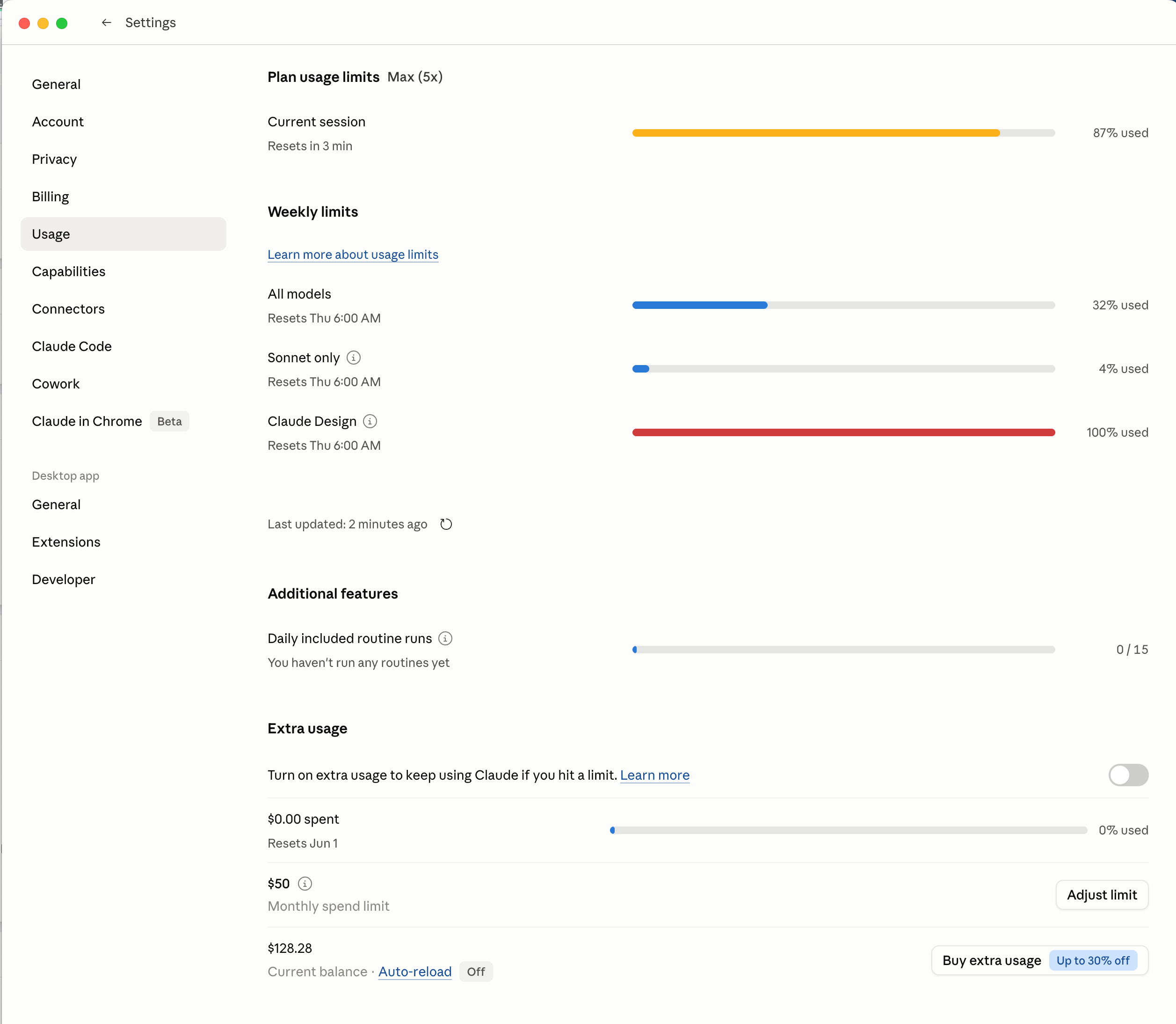
The screenshot says everything.
A “Current session” limit.
Separate “Weekly limits.”
Different pools for “All models,” “Sonnet only,” and “Claude Design.”
A reset timer.
A spend cap.
Extra usage toggles.
Progress bars everywhere.
At some point this stopped feeling like software and started feeling like managing an airline loyalty account.
And to be fair, the underlying reason is obvious: frontier AI inference is expensive. Especially coding agents running long-context sessions, tool calls, terminals, file indexing, retrieval, and iterative reasoning loops.
Most serious users understand this.
The problem is not that limits exist.
The problem is what happens when users hit them.
Because right now, many AI coding systems behave like the collaboration itself never mattered.

The Real Failure Is Losing State
You spend hours inside a coding session:
refining architecture
debugging edge cases
teaching the model your codebase
iterating on patterns
establishing conventions
making design decisions
building momentum
Then suddenly:
“You’ve hit your usage limit.”
Session over.
The context evaporates.
The model forgets the collaboration that took hours to build.
So users have to struggle later to reconstruct state manually:
re-uploading files
re-explaining architecture
summarizing prior decisions
rebuilding conventions
recreating project context
This is absurd.
Imagine Photoshop deleting your layers because your GPU quota reset.
Imagine Figma forgetting your component hierarchy because you exceeded vector operations.
Imagine VS Code wiping open tabs because TypeScript indexing hit a plan limit.
That would never be accepted in professional software.
Yet somehow AI systems normalized disposable collaboration state.
Developers Are Increasingly Complaining About This
And this is not an isolated frustration.
Across Reddit, GitHub, Medium, Facebook groups, and developer forums, users are increasingly describing the same pattern:
Not just “the limits are annoying.”
But:
“The interruption destroys workflow continuity.”
There are GitHub issues from developers saying they hit Claude Code limits in just 1-2 hours during normal engineering work.
Others describe having to repeatedly re-explain:
project structure
architecture
coding conventions
organizational context
previous decisions
One GitHub issue made the deeper point directly:
“Long sessions are a workaround for missing persistent context.”
That is exactly right.
Users are stretching sessions unnaturally long because they are afraid of losing accumulated understanding.
The system trained users to fear interruption.
AI Companies Are Optimizing the Wrong Metric
Most frontier AI companies are currently obsessed with:
model benchmarks
token throughput
inference efficiency
GPU utilization
reasoning quality
But users increasingly care about:
continuity
recoverability
persistent memory
collaboration stability
interruption handling
The smartest model in the world still feels broken if it repeatedly wipes working state.
Especially in coding.
Especially in design.
Especially in research workflows.
Because these are not single-prompt interactions anymore.
They are long-horizon collaborative sessions.
AI Coding Has Become Stateful Work
Modern AI coding is not:
prompt → answer
It increasingly looks like:
multi-hour collaboration
evolving architecture
iterative debugging
shared conventions
layered context accumulation
strategic tradeoff discussions
project memory formation
The context is the work.
Losing context means losing momentum.
And momentum is one of the most valuable things AI coding tools currently provide.
This is the shift many AI companies still seem to underestimate.
The user is no longer asking a chatbot a question.
They are building a temporary working relationship with a reasoning system.
Users Are Already Building Workarounds
The craziest part is that users are already compensating for this weakness themselves.
Because the products do not properly preserve continuity, entire workaround cultures are emerging.
People are:
maintaining markdown memory files
building “session resurrection” prompts
manually summarizing state
exporting context snapshots
creating persistent
/contextworkflowsexternalizing project memory into documents
In other words:
users are inventing operating systems around missing persistence.
That is usually a sign the product architecture is missing something fundamental.
Claude Code Makes This Worse Because It’s Actually Good
This is the irony.
Claude Code is good enough that people build real momentum with it.
Developers are using it for:
production applications
serious refactors
infrastructure work
architecture planning
debugging loops
documentation systems
design system implementation
The better the collaboration becomes, the more painful state loss becomes.
Because now the interaction has depth.
You are no longer generating isolated outputs.
You are building accumulated understanding over time.
And then the system abruptly forgets everything.
Compute Limits Are Fine. Disposable Context Is Not.
This is the important distinction.
Most serious users are not demanding infinite free compute.
They understand:
GPUs cost money
inference is expensive
power users consume enormous resources
Fine.
Pause generation if necessary.
Throttle throughput.
Queue requests.
Reduce model availability temporarily.
But preserve the collaboration state.
A better system would say:
“You’ve reached your compute limit. Your working session has been preserved. Resume anytime after reset.”
That changes the emotional experience completely.
Now the interruption is inconvenient instead of destructive.
The Deeper Problem: AI Systems Still Treat Context as Disposable
This problem goes far beyond Claude.
Most AI systems still fundamentally treat context as temporary runtime scaffolding instead of durable collaboration state.
That mindset made sense when AI chat was mostly:
simple prompts
lightweight Q&A
disposable conversations
But that world is ending.
AI systems are increasingly becoming:
coding collaborators
design partners
research assistants
strategic thinking tools
long-horizon work environments
And long-horizon work requires continuity.
No serious creative or engineering tool survives by constantly erasing working state.
AI products will not be different.
The Companies That Win Will Preserve Human Momentum
The future AI leaders probably will not win solely because they have the highest benchmark scores.
They will win because they build systems that best preserve:
project memory
collaboration continuity
accumulated understanding
human momentum
Because knowledge work is momentum.
And right now, AI systems are still far too willing to throw it away.